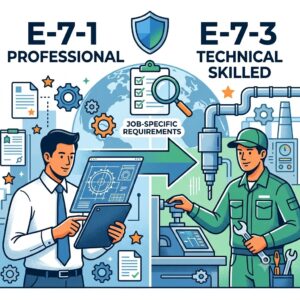
When a Korean manufacturer plans to hire a foreign technical worker under an E-7 visa, the first things usually checked are education, work experience, salary, and employer requirements.
These requirements are important. However, as the E-7 system becomes more diverse, simply asking “Does the applicant meet the requirements?” may not be enough.
For manufacturing companies, three practical questions are particularly important:
Why does our factory need this skill?
Why is a foreign technical worker needed for this job?
How do the worker’s experience and technical skills connect to the actual work at the factory?
1. E-7 Is Becoming More Strategic
Different factories require different skills.
One manufacturer may need workers with precision machining experience, while another may need experience related to molds and dies, press work, injection molding, welding, or production equipment.
Therefore, instead of asking only:
“Can this person qualify for an E-7 visa?”
it can be more useful to ask:
“Which E-7 category and occupation best fit this person’s skills and our factory’s actual job?”
2. Working for a High-Tech Company Does Not Automatically Make Every Job High-Tech
What matters is the work the foreign employee will actually perform.
Even at a company producing advanced automotive components, simple transportation, packaging, or general production assistance may be very different from technical work.
On the other hand, work involving specific production equipment, precision machining, mold-related functions, or process management may present a clearer technical function.
3. Actual Duties Matter More Than the Job Title Alone
Instead of simply describing someone as a “mechanical technician,” it is useful to identify the equipment they operate, the production process they participate in, and the technical functions they actually perform.
Relevant manufacturing fields may include:
CNC · MCT · Mold & Die · Press Work · Injection Molding · Welding · Machining · Automotive Parts Manufacturing · Production Equipment
However, mentioning one of these technologies does not automatically make a job eligible for an E-7 visa.
The key question is not only:
“What machine can this person operate?”
but:
“What technical function does this person perform in the production process?”
4. The Factory’s Need for the Skill Should Also Be Clear
Simply saying “We do not have enough workers” may not fully explain the need for a foreign technical worker.
A clearer structure is:
Product → Production Process → Required Skill → Missing Function → Foreign Worker’s Experience
The important point is not merely that the company needs a foreign worker.
It is that the company needs a worker capable of performing a specific technical function.
5. Years of Experience Alone Do Not Tell the Whole Story
A certificate stating “Five years of experience at an automotive parts factory” does not necessarily explain what the candidate can actually do.
Five years of general production assistance and five years of CNC-related work can represent very different experience.
A useful structure is:
Previous Employer → Products → Process → Equipment → Actual Duties → Technical Skills
All descriptions should, of course, be based on genuine and verifiable experience.
6. The Worker’s Skills Should Connect to the Korean Factory Job
If a foreign worker has genuine mold-related experience and the Korean employer genuinely needs a worker for related technical functions, the relationship can be explained as:
Previous Experience → Technical Skills → Korean Production Process → Actual Job in Korea
The clearer this connection is, the easier it becomes to understand the employment relationship.
7. Salary and Organizational Role Should Also Make Sense
If a company describes a foreign worker as an important technical professional while the actual duties and organizational role look like simple assistance, the overall explanation may appear inconsistent.
Therefore, it is useful to consider whether the following elements fit together:
Technical Level ↔ Actual Duties ↔ Responsibility ↔ Salary ↔ Organizational Role
8. A Good E-7 Application Connects Facts Rather Than Creating Them
Designing an E-7 application does not mean exaggerating a candidate’s experience or creating duties that do not actually exist.
The goal is to accurately identify the company’s genuine technical needs and the foreign worker’s genuine experience and explain how they connect.
For manufacturing companies:
Product → Process → Required Skill → Foreign Worker’s Experience → Actual Job
This is one of the clearest ways to understand the overall structure.
Conclusion
For manufacturing E-7 cases, it is important to look beyond education, experience, and salary requirements.
Companies should also consider what technical skills the foreign worker actually has, why those skills are needed in the factory, and what work the person will actually perform in Korea.
The core structure is:
Foreign Worker’s Skills → Employer Need → Actual Job → Appropriate E-7 Route