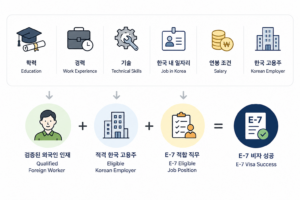
What is the E-7 Visa?
The E-7 visa (Specially Designated Activities) is a Korean employment visa for foreign nationals with professional, technical, or skilled qualifications required by Korean companies. Unlike the E-9 visa, which mainly covers non-professional employment, the E-7 visa is designed for workers who possess relevant education, professional experience, technical skills, or other qualifications required for an eligible occupation. While E-9 is primarily a non-professional employment program, E-7 can provide qualified skilled workers with a pathway toward a longer-term career and residence in Korea
Why is the E-7 Visa Attractive to Foreign Workers?
One of the biggest advantages of the E-7 visa is that it can offer more than simply an opportunity to work in Korea for a limited period.
For qualified workers, it can become the beginning of a long-term career and residence pathway in Korea.
① Potential for Long-Term Employment in Korea
An E-7 visa holder may continue working in Korea by extending his or her period of stay, provided that the applicable immigration and employment requirements continue to be satisfied.
This makes the E-7 visa particularly attractive to skilled workers who want to build a long-term career in Korea rather than work for only a limited period and return home.
② Possibility of Bringing Spouse and Children
Subject to applicable immigration requirements and approval, an E-7 visa holder may be able to bring his or her spouse and minor children to Korea under F-3 dependent status.
This can be a major advantage for skilled workers who are considering living and working in Korea for an extended period.
Family visas are subject to separate immigration review and are not automatically granted simply because the worker has obtained an E-7 visa.
③ Potential Pathway to Permanent Residency
The E-7 visa can also be part of a longer-term immigration pathway.
After legally residing and working in Korea for the required period, an E-7 holder who satisfies the applicable requirements relating to income, Korean-language ability, social integration, conduct, and other immigration criteria may potentially qualify for F-2 residence status or F-5 permanent residency.
A possible long-term pathway may therefore look like:
E-7 Employment→ Build Career & Income in Korea→ Long-Term Legal Residence→ F-2 or F-5 if Eligible→ Potential Long-Term Settlement in Korea
However, obtaining an E-7 visa does not automatically guarantee F-2 residence or F-5 permanent residency.
④ Opportunity to Build a Skilled Career in Korea
E-7 workers are recruited based on their professional or technical capabilities.
Depending on the applicable E-7 occupation and immigration requirements, potential fields may include:
-
Welding
-
CNC / MCT machining
-
Machinery
-
Mold and die
-
Metal processing
-
Electrical and electronics
-
Automotive parts
-
Shipbuilding-related technical work
-
Industrial equipment
-
Other eligible professional, technical, and skilled occupations
Experience gained with a Korean company can also help workers develop their professional careers.