Korea Expands E-7-3 Visa Opportunities for Foreign Skilled Workers in the Automotive Parts Industry
South Korea is creating new employment opportunities for foreign skilled workers in the automotive parts manufacturing industry.
Gwangju Metropolitan City has launched a pilot program using the E-7-3 visa for foreign skilled workers to address labor shortages in local automotive parts companies.
The program is particularly focused on skilled workers in mold and die, forming, and welding-related fields.
What Is the E-7-3 Visa?
The E-7-3 is a Korean employment visa for foreign workers with specific technical or functional skills.
Traditionally, the visa has been used for designated occupations in industries such as shipbuilding and aircraft manufacturing.
However, severe labor shortages in Korea’s automotive manufacturing sector have created demand for skilled foreign workers in additional manufacturing fields.
The new pilot program therefore allows qualified foreign workers to work in selected automotive parts manufacturing positions.
Skilled Workers Needed in Three Major Fields
The pilot program focuses primarily on three areas:
- Mold and die
- Forming
- Welding
The purpose of the program is to recruit foreign workers with relevant technical skills rather than simply increase the number of general production workers.
This could create new opportunities for foreign workers who already have manufacturing experience in their home countries.
Pilot Program in Four Regions
Four regions were selected for the pilot program:
Gwangju, Gyeongsangbuk-do, Chungcheongbuk-do, and Chungcheongnam-do.
The program targets automotive parts manufacturers located outside the Seoul metropolitan area with approximately 30 to 299 employees.
In Gwangju, the program is scheduled to operate for two years, from October 2025 to September 2027.
A total of 100 foreign skilled workers are planned under the program, with 40 positions initially allocated in the first year.
Future allocations may be adjusted depending on the results of the pilot program.
Strong Demand from Korean Automotive Companies
Demand from local companies has already been significant.
A survey conducted among automotive parts manufacturers in Gwangju found that 16 companies requested a total of 122 foreign skilled workers.
This indicates that the demand for skilled manufacturing workers exceeds the initial number of available positions.
The Korea Automotive Technology Institute is responsible for managing the program.
Foreign candidates may undergo skills assessments before being matched with participating Korean companies.
New Opportunities for Foreign Skilled Workers
The pilot program may be particularly relevant to foreign workers with professional experience in areas such as:
Welding · Mold and Die · Forming · Automotive Parts Manufacturing
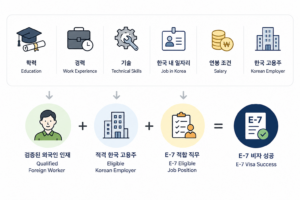
Applicants interested in E-7 employment in Korea should understand that professional experience and technical capability can be important parts of the qualification process.
Therefore, workers planning to apply for skilled jobs in Korea should prepare reliable documentation proving their education, employment history, technical experience, and relevant skills.
Could Korea Expand the Program?
The automotive parts program is currently a pilot project rather than a nationwide employment system.
However, its results could be important for the future of Korea’s skilled foreign worker policy.
If participating companies successfully address their labor shortages through the program, similar opportunities could potentially expand to additional companies, regions, or manufacturing fields.
Korea’s automotive industry is also undergoing a major transition from conventional internal-combustion vehicles toward electric, hydrogen, and other future mobility technologies.
Maintaining a stable supply of skilled manufacturing workers will therefore remain an important issue for Korean automotive parts companies.
For foreign workers with relevant technical experience, the expansion of E-7 visa pathways into automotive manufacturing is an important development to watch.
Disclaimer
This article is provided for general information about employment and E-7 visas in South Korea. Visa eligibility and employment requirements may vary depending on the occupation, employer, region, applicant’s experience, and current Korean immigration regulations. Applicants should always check the latest official requirements before applying.
Source: Maeil Labor News, “Gwangju Launches Two-Year E-7 Visa Pilot Program for Automotive Parts Industry.”