2026 E-7 Visa Changes: 94 Eligible Occupations Confirmed and E-7-4 Employment Limit Expanded
Changes to Korea’s E-7 Visa System in 2026
The Korean Ministry of Justice has updated the list of designated occupations under the E-7 (Specific Activities) visa program for 2026.
A total of 94 occupations are included in the updated E-7 framework. Changes have also been introduced to the E-7-4 Skilled Worker visa, particularly regarding employment limits and Korean-language requirements.
These changes are important not only for foreign nationals seeking professional or skilled employment in Korea, but also for Korean companies planning to hire foreign workers.
What Is the E-7 Visa?
The E-7 visa allows foreign nationals with professional knowledge, technical skills, or specialized abilities to work in designated occupations in Korea.
The E-7 visa is divided into several categories, including:
- E-7-1: Professional Workers
- E-7-2: Semi-Professional Workers
- E-7-3: General Skilled Workers
- E-7-4: Skilled Workers
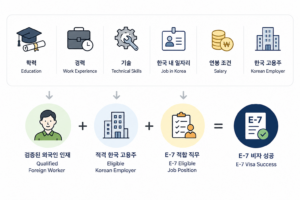
Simply receiving a job offer from a Korean company does not automatically qualify a foreign worker for an E-7 visa.
Immigration authorities may review whether the occupation is eligible under the E-7 system and whether the applicant satisfies requirements related to education, work experience, qualifications, salary, and employment conditions.
E-7-4 Employment Limit May Increase to 50%
One of the most notable changes concerns the number of E-7-4 skilled foreign workers that eligible employers may hire.
According to the report, the employment limit in the agriculture, livestock, and fisheries sectors has been adjusted so that the previous 30% limit may be increased to as much as 50%.
This could give employers facing skilled labor shortages greater flexibility in hiring foreign workers.
However, this should not be interpreted as meaning that every company can automatically employ foreign workers up to 50% of its workforce.
The applicable limit may depend on factors such as the industry, number of Korean employees, current foreign workforce, and other immigration requirements.
Korean-Language Requirements Have Also Been Adjusted
Korean-language proficiency is an important requirement for the E-7-4 visa.
The updated rules provide more specific conditions regarding the temporary deferral of Korean-language requirements.
This means that certain applicants who do not fully satisfy the Korean-language requirement at the time of application may be able to receive a temporary grace period if they meet the applicable conditions.
However, this does not mean that Korean-language proficiency is no longer required for the E-7-4 visa.
Foreign workers who plan to work and live in Korea for the long term should continue studying Korean and prepare to satisfy the required language standard within the applicable period.
What Foreign Workers Should Check
Foreign workers preparing for an E-7 visa should not determine their eligibility based only on the name of their occupation.
Immigration authorities may consider several factors, including:
occupation classification, education, work experience, professional qualifications, salary, employment contract, and the employer’s eligibility.
Even jobs that appear similar may fall under different E-7 occupation classifications depending on the actual duties described in the Job Description.
Therefore, applicants should carefully confirm the correct occupation and eligibility requirements before signing an employment contract or submitting a visa application.
What Korean Employers Should Prepare
Korean companies planning to hire foreign workers under an E-7 visa should also prepare carefully before recruitment.
The employee’s actual job duties should be clearly defined and should correspond to an eligible E-7 occupation.
Employers should also review salary requirements, working conditions, social insurance obligations, and documents that may be required during the immigration review process.
For E-7-4 workers in particular, companies should check their current number of Korean and foreign employees because employment limits may apply.