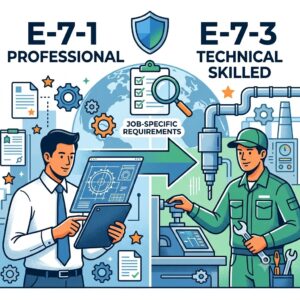
If a manufacturing company in Korea plans to hire foreign technicians, one of the first things to determine is which E-7 visa category and occupation applies: E-7-1 or E-7-3.
“Can an experienced factory technician qualify for an E-7 visa?”
“Can all factory technicians apply under E-7-3?”
“Is CNC or mold-related experience enough to apply for an E-7 visa?”
In practice, the answer cannot be determined simply by the number of years of experience or by calling someone a “technician.”
When reviewing an E-7 application, it is important to consider what business the company actually operates, what duties the foreign worker will perform, whether the E-7 occupation matches the worker’s education and experience, and whether the salary and employment conditions meet the applicable requirements.
Because E-7-1 and E-7-3 cover different types of workers, the first step is to identify the actual job duties.
What is the biggest difference between E-7-1 and E-7-3?
What Is the Biggest Difference Between E-7-1 and E-7-3?
E-7-1 applies to professional personnel, while E-7-3 applies to general skilled personnel.
Therefore, simply having many years of experience in manufacturing does not automatically determine whether a worker should apply under E-7-1 or E-7-3.
Suppose a foreign worker has worked at an automotive-parts factory for seven years.
The statement “7 years of experience in an automotive-parts factory” alone does not tell us the worker’s actual technical level or duties.
Did the worker operate specific equipment? What products did the worker manufacture? Did the worker perform technical duties such as machine setup or adjustment of machining conditions? Or was the work mainly simple production?
These differences matter.
Therefore, the question should not only be:
“How many years did the person work?”
It should also be:
“What work did the person actually perform during those years?”
Does long manufacturing experience help with an E-7 application?
Does Long Manufacturing Experience Help With an E-7 Application?
The length of experience matters, but its relevance to the E-7 occupation being applied for is also important.
Consider a company hiring a CNC-related technician.
If the career certificate simply states:
“Production Worker”
it may be difficult to determine what technical work the person actually performed.
By contrast, experience becomes much clearer when the actual duties include:
- CNC machine operation
- Reading technical drawings
- Machine setup
- Tool setup and replacement
- Checking machining conditions
- Product dimension measurement
- Identifying machining defects
What matters is not only the job title on the career certificate but the actual duties performed.
The company’s required technical skills should connect naturally with the foreign worker’s previous experience.
Can every factory technician apply for E-7-3?
Can Every Factory Technician Apply for E-7-3?
No.
Although E-7-3 covers general skilled personnel, the specific occupation and its individual requirements must still be checked.
For example, suppose a company needs a mold technician.
Before deciding, “We need a mold technician, so we will hire one under E-7,” the company should identify the actual duties.
Will the worker manufacture molds?
Repair and maintain molds?
Set up molds?
Operate production equipment?
Or simply produce goods using machines equipped with molds?
These are not necessarily the same type of work.
Therefore, rather than choosing a visa occupation first and trying to fit the worker into it, it is better to identify the actual duties first and then determine the appropriate E-7 occupation.
Is matching the foreign worker’s experience enough for an E-7 application?
Is the Foreign Worker’s Experience Alone Enough?
The company’s conditions are just as important as the foreign worker’s qualifications.
An E-7 review is not limited to the worker’s education and experience.
It is also necessary to examine the company’s actual business, the duties assigned to the foreign worker, and whether those duties are genuinely connected to the company’s business and production structure.
Before hiring a foreign technician, it is useful to organize information such as:
- Actual business activities
- Specific duties of the foreign worker
- Department and workplace
- Annual salary and employment conditions
- Number of Korean employees
- Existing E-7 foreign employees
- Production process where the foreign worker will work
For factory technicians in particular, the worker’s experience and the company’s actual production process should connect naturally.
How does a company’s production process relate to the E-7 occupation?
How Does the Production Process Relate to the E-7 Occupation?
Suppose an automotive-parts manufacturer wants to hire a CNC-related technician.
Rather than simply stating:
“Our company needs a CNC technician,”
it is more useful to follow the actual production structure.
What products does the company manufacture?
↓
What machining processes are required?
↓
Does the company actually have the relevant equipment?
↓
What technical work must be performed using that equipment?
↓
Does the foreign worker have relevant experience?
The logical connection is:
Company → Product → Production process → Required technical skill → Worker’s experience → Actual duties
Can similar manufacturing experience be evaluated differently for E-7?
Can Similar Manufacturing Experience Be Evaluated Differently for E-7?
Yes. Workers with the same number of years in the same industry may have performed very different duties.
Suppose two workers each spent seven years at automotive-parts factories.
Worker A operated CNC equipment and handled machine setup, tool replacement, machining-condition checks, and product measurements.
Worker B mainly handled product movement, packaging, and simple assembly.
Both may write “7 years of automotive-parts manufacturing experience” on a résumé.
However, the substance of their technical experience is quite different.
That is why it is important to check specific job duties, not just the company name or length of employment.
Do E-7-1 and E-7-3 have salary requirements?
Do E-7-1 and E-7-3 Have Salary Requirements?
Yes. The applicable salary requirements for the relevant year should be checked.
For 2026, the basic salary thresholds discussed here are:
E-7-1 professional personnel: KRW 31.12 million or more per year
E-7-3 general skilled personnel: KRW 25.89 million or more per year
However, these figures should not automatically be assumed to apply identically to every occupation.
Certain occupations may have separate salary requirements or additional conditions. Therefore, the requirements for the specific occupation should be checked before applying.
Meeting the salary threshold alone also does not automatically satisfy all other E-7 requirements.
Can E-7 eligibility differ between foreign workers hired by the same company?
Can E-7 Eligibility Differ Between Workers at the Same Company?
Yes.
Even if the same company plans to hire several foreign workers for similar positions, each worker may have different education, experience, and actual previous duties.
For example, Worker A may have extensive CNC experience involving equipment operation and setup.
Worker B may have worked in manufacturing for many years but mainly performed simple production work.
Both are manufacturing workers, but the relevance of their experience to the intended E-7 occupation may be different.
What should a company determine before looking for a foreign technician?
What Should a Company Determine Before Recruiting a Foreign Technician?
It is better to define the technical manpower the company actually needs before searching for candidates.
Ask:
What products does the company manufacture?
Which production process requires technical personnel?
What will the foreign worker actually do?
What education and experience are required?
What equipment must the worker be able to operate?
Where will the worker work?
What salary and employment conditions will be offered?
Instead of simply recruiting a “CNC-experienced worker,” the company can define the requirement more precisely:
“A technician with automotive-parts CNC machining experience who can read drawings, set up machines, replace tools, check machining conditions, and measure finished products.”
What should be checked first when hiring an E-7 foreign technician?
What Should Be Checked First When Hiring an E-7 Foreign Technician?
A useful sequence is:
Company’s business
↓
Products
↓
Actual production process
↓
Required technical skill and job
↓
Applicable E-7 occupation
↓
Worker’s education and actual experience
↓
Specific duties in Korea
↓
Salary and employment conditions
Therefore, before asking:
“Which visa is easier?”
it is better to ask:
“What technical skills does our company actually need, and does this foreign worker’s experience match those duties?”